Mel Reusche, WGNHS Communications and Outreach Specialist, Sue Swanson, WGNHS Director and State Geologist, and Moe Muldoon, WGNHS Hydrogeologist, retired
WGNHS hydrogeologist Maureen Muldoon (Moe) retired this summer after a long and productive career, and we wanted to ask her about her experience and for any advice she would give to early career scientists!

Moe is a widely known expert on flow in fractured carbonate aquifers. Her work contributed to improvements in our understanding of geologic controls on groundwater flow and the impacts of land use on groundwater quality in both northeastern and southwestern Wisconsin. In addition to a long list of publications on these topics, she also frequently shared her knowledge nationally and internationally by teaching workshops and short courses for professionals, often through the Midwest GeoSciences Group. Moe’s experience as an educator goes beyond her outreach activities with Extension, having served as a Professor of Geology at UW–Oshkosh for 21 years. She started her career with WGNHS in 1987 and returned in 2019 to head up the comprehensive Southwest Wisconsin Groundwater and Geology (SWIGG) study. Moe’s dedication to service, outreach, and mentoring of colleagues earned her the Supporter Award from the Natural Resources Institute (Div. of Extension, UW–Madison) in 2025.
How did you first come to work at the WGNHS? What are the biggest changes you have seen here?
I first worked for the WGNHS from 1987 to 1998, starting right after I finished my master’s degree. I worked half-time while getting my PhD and finished in 1998, then moved to UW–Oshkosh where I taught for 21 years. I returned to the WGNHS in 2019. The big change over that time was technology. When I first started, we wrote letters to folks who had questions and kept copies in drawers in the front office. We had faxes (and no email); there was no Zoom or Teams. Field monitoring equipment has come a long way. It’s now easy to monitor water-quality parameters and water levels in a well and receive the data through telemetry and use solar panels to power the equipment. I used to drive to Door County every month to download our dataloggers and change out the batteries. And I was the young person when I started, all the staff were considerably older than me, now I’m the oldster.
What is a favorite memory from your time here? I am sure there are some good fieldwork stories!
Lots of good memories—teaching a groundwater modeling short course with Ken Bradbury (WGNHS Director, retired) in Lativia sponsored by U.S. Environmental Protection Agency; staff field trips; public meetings at the end of county groundwater inventories with Prof. Fred Madison, who seemed to know everyone; making baby quilts for the new moms in the office.
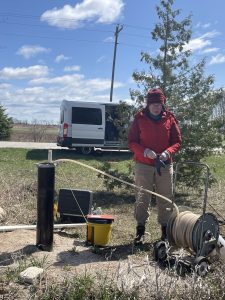
Field work was always fun, especially the Door County groundwater tracer tests where lots of folks came to help—Jean Bahr’s [UW–Madison, Professor Emerita] hydrogeology field class and Door County Soil and Water folks. There were the occasional mishaps—losing the natural gamma probe down a homeowner’s new well and having said homeowner arrive and ask if I was “getting all the data that I needed?”; not understanding how to switch fuel tanks on the big moving truck and stalling out on old Hwy 151, with the sheriff eventually arriving.
You have had such a lasting impact at WGNHS and across the state. What project or accomplishment are you really proud of?
I’m most proud of the code changes to the Wisconsin State Legislature’s Chapter NR 151, and its standards that limit manure applications in areas where the depth to rock over the Silurian groundwater aquifer is < 20 ft. Those changes came about because of all the research on the hydrogeology of Silurian bedrock in eastern Wisconsin, some conducted at WGNHS and some while I was at UW–Oshkosh. I was the only hydrogeologist on the Technical Advisory Committee that made recommendations to Wisconsin’s Dept. of Natural Resources as to how the code should change.
What are you looking forward to in retirement? Any advice for early career geoscientists?
I am looking forward to more time for house and yard projects, Scamping trips, trying to visit all the National and Wisconsin State Parks, and international travel, adding to my birding life list. Basically, not working 40 hrs/week.
As for advice, collaborate broadly so that you’re always learning new stuff but try to have an area of specialty where you’re the expert.
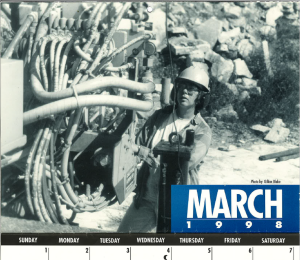
“To prepare for this field, I recommend taking all the math and science you can at both the high school and college level.” – Moe, Women in Trades and Technology 1998
Explore Moe’s work:
Article: “Southwest Wisconsin Groundwater and Geology Study (SWIGG) Study”
Open File Report: “Assessing Groundwater Quality in Kewaunee County, Wisconsin…”
Recorded public presentation: “PBS Wisconsin: Wisconsin Karst Aquifers”