Mel Reusche, WGNHS Communications and Outreach Specialist, Sue Swanson, WGNHS Director and State Geologist, and David Hart, WGNHS Hydrogeologist, retired

WGNHS hydrogeologist David Hart (Dave) retired this summer after a long and productive career, and we wanted to ask him about his experience and for any advice he would give to early career scientists!
Dave used his expertise in hydrogeology, physics, and rock mechanics to advance the field of hydrogeology at WGNHS for nearly 25 years. His publication record includes dozens of peer-reviewed articles in scientific journals in addition to many reports published by the WGNHS. At the WGNHS, Dave developed and applied near-surface geophysical techniques to geologic and hydrogeologic problem solving, and he built a reputation as an expert in these techniques within Wisconsin and across the Midwest. Over the years, he applied his expertise to important water-related topics, shifting and innovating as new questions and new needs emerged. In recognition of his work, Dave was awarded the Excellence in Research Award from the Division of Extension (UW–Madison) in 2025. Throughout his time at WGNHS, Dave served as a mentor for many students, early career scientists, and collaborators both at the Survey and across Wisconsin.
How did you first come to work at the WGNHS? What are the biggest changes you have seen here?
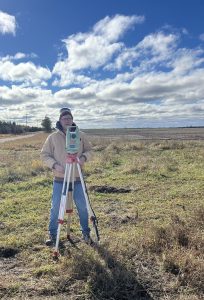
After graduating [with a PhD from UW–Madison], I took a postdoctoral position with [Prof.] Nik Christensen at UW-Madison and worked on crustal seismic velocities. My goal had been to get a job at a college or university. The Survey job opened up, and I applied since my wife and I both loved Madison. The applied nature of the job appealed to me as well.
The work has become more digitized with more data and better analysis. We can readily know where we are with GPS, record the setting with a digital photo, and connect to instruments and send the data to our office all with the phone in our pocket. There still seems to be a need for humans to develop conceptual models of the flow systems and judge whether those models are appropriate based on data and analysis. I’ll be interested in how the roles of humans and computers evolve over next 10 to 20 years.
What is a favorite memory from your time here? I am sure there are some good fieldwork stories!
Standing on a ridge top near La Crosse, listening to water cascade down a well from one aquifer to another and wondering if that flow was nature’s way of doing a pumping test for us, could it be used to get hydraulic conductivities. Of course, the math and theory were all worked out in 1967.
Working with some very talented and smart students and colleagues always made for a good day in the field. Wisconsin has a top-notch groundwater community, and I always felt lucky to have worked here.
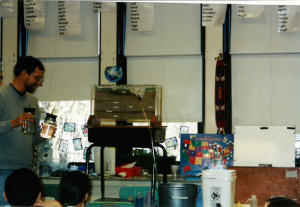
You have had such a lasting impact at WGNHS and across the state. What project or accomplishment are you really proud of?
That question is too hard to answer. The best projects were the ones where science is used to make decisions. I found I love the wetlands, small little streams, big rivers, and the lakes found across Wisconsin from the Central Sands to the Driftless Area to the northern highlands to the Kettle Moraine. I realize I mentioned surface water features, but I’ve heard it said that groundwater and surface water are connected.
What are you looking forward to in retirement? Any advice for early career geoscientists?
First, I plan to catch up on my reading and ridding the garden of weeds. Then we’ll take the dog on some long camping trips.
I feel like the earth scientist job landscape is changing rapidly so any advice I give may not be applicable. Perhaps the ability to join two fields, some examples; geophysics and hydrogeology, carbonate geology and hydrogeology, or wetland ecology and hydrogeology. I would always recommend reading T.C. Chamberlin’s “The Method of Multiple Working Hypotheses” as a way to keep our science honest.

Explore Dave’s work:
Map and report: “Depth to Silurian Bedrock in Eastern Wisconsin”
Bulletin: “Effects of Climate Change on Stream Temperature in the Marengo River Headwaters”